
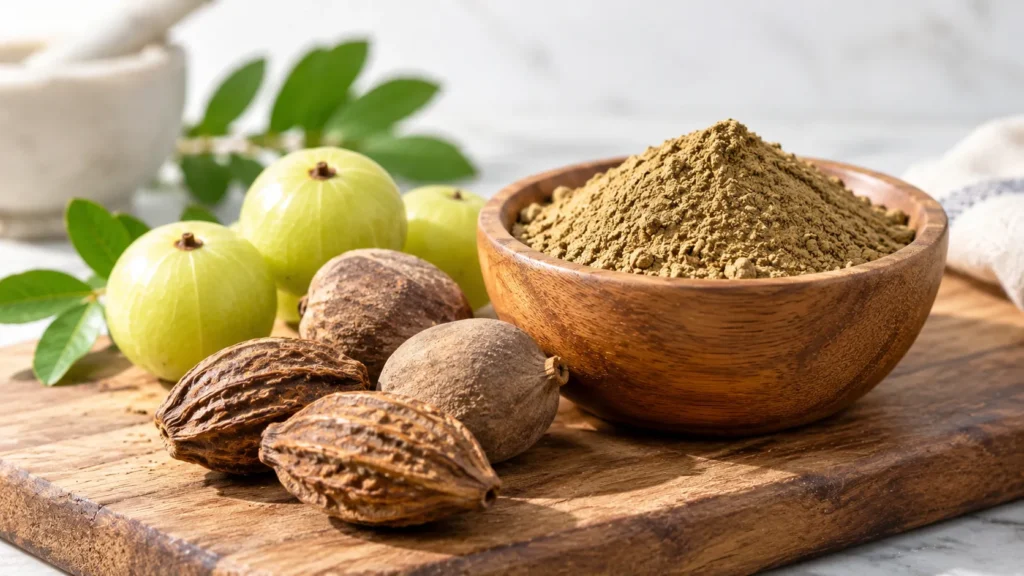
Triphala benefits are one of the reasons this traditional Ayurvedic formulation continues to attract interest among people looking for simple ways to support everyday wellness.
Triphala is one of the most well-known herbal formulations in Ayurveda. Made from three traditional fruits, it has been used for generations as part of daily wellness, particularly for digestion and bowel regularity.
Today, Triphala is available as powder, tablets and capsules, making it easy to include in a routine. But knowing how to use Triphala, when to take it, and what benefits you can realistically expect is just as important as choosing the product itself.
In this guide, we’ll look at the traditional uses of Triphala, what current research suggests, the best time to take it, and a few things to keep in mind before making it part of your routine.
Table of Contents
What Is Triphala?
The word Triphala means “three fruits.” It is traditionally prepared by combining the dried fruits of Amalaki (Amla), Bibhitaki and Haritaki.
Each fruit has its own place in Ayurveda, and together they form a balanced herbal preparation that has traditionally been used to support digestion and general well-being. Triphala also contains naturally occurring plant compounds, including polyphenols and tannins, which have antioxidant activity.
While Triphala has a long history of traditional use, modern research is still exploring many of its potential benefits. Some areas look promising, but not every health claim commonly made about Triphala has been established in good-quality human studies.
Triphala has a long history of traditional Ayurvedic use, and modern researchers have also examined its potential health effects. Learn more about Triphala research and its traditional uses.
Triphala Benefits
Triphala is often described as an all-purpose Ayurvedic remedy, but its most practical traditional use is connected with digestion and bowel health. Research has also explored its antioxidant, metabolic and oral-health properties.
Here are the main Triphala benefits worth knowing about.
1. Supports Healthy Digestion
Digestive support is probably the most familiar use of Triphala. Traditionally, it has been used to help maintain healthy digestion and comfortable bowel movements.
Triphala may be particularly useful for people who occasionally experience sluggish digestion or irregular bowel movements. Its mild laxative action is one reason it has traditionally been included in digestive routines. However, persistent constipation or recurring digestive symptoms should not simply be treated with Triphala without finding the underlying cause.
Also read: 7 Powerful Black Pepper Water Benefits (Ayurvedic Way)
2. Helps Maintain Bowel Regularity
Triphala is commonly used as part of a routine for maintaining regular bowel movements. Unlike a strong stimulant laxative, it is traditionally regarded as a gentler digestive preparation.
If your goal is simply to keep digestion regular, Triphala works best alongside everyday habits such as eating enough fiber, drinking adequate water and staying physically active. It should not be seen as a substitute for these basics.
Also read: 7 Best Drinks for Liver Health
3. Provides Antioxidant Support
Another interesting Triphala benefit comes from the natural compounds found in its three fruits.
Triphala contains polyphenols and other plant compounds with antioxidant activity. Antioxidants help protect cells from oxidative stress, which is one reason researchers continue to study Triphala and its individual ingredients.
However, antioxidant activity observed in laboratory research does not automatically mean that Triphala can prevent or treat a particular disease in humans. This is an area where more clinical research is needed.
Also read: Saunf Water Benefits for Digestion
4. May Support Metabolic Health
Triphala has also been studied for its possible role in metabolic health.
A systematic review of 12 randomized controlled trials involving 749 people found that some studies reported improvements in cholesterol, triglycerides, fasting blood glucose, body weight, BMI and waist circumference. At the same time, the researchers noted that larger and better-designed studies are needed to confirm these effects.
So, while the results are interesting, it would be misleading to call Triphala a proven treatment for diabetes, high cholesterol or weight loss.
Research on Triphala is still developing, but studies have explored its potential effects on areas such as digestion, blood sugar, cholesterol and body weight. Read the systematic review on Triphala and its health effects.
Also read: Boost Metabolism Naturally with Ayurveda
5. May Support Oral Health
Triphala’s benefits are not limited to digestion. It has also been studied in relation to oral health.
Some clinical research suggests that Triphala preparations may help reduce dental plaque and may have antibacterial activity in the mouth. However, it is not clear whether Triphala works as well as established dental treatments, so it should not replace regular brushing, flossing or professional dental care.
6. May Have Anti-Inflammatory Potential
The natural compounds in Triphala have shown anti-inflammatory effects in laboratory and animal research.
This has made the formulation interesting to researchers studying inflammation and other health conditions. However, human evidence is still limited, so Triphala should not be presented as a treatment for inflammatory diseases.
Also read: 7 Powerful Ayurvedic Drinks for Belly Fat Loss (Naturally & Effectively)
7. May Support General Wellness
Beyond individual health concerns, Triphala has traditionally been used as a general wellness formulation.
Its combination of three fruits provides a variety of naturally occurring plant compounds, and its long history in Ayurveda is one reason it remains popular today. Still, it is better to think of Triphala as one possible part of a healthy routine, rather than something that can provide every health benefit on its own.
These potential Triphala benefits should be viewed in the context of both traditional Ayurvedic use and the current scientific evidence.
Modern research has explored Triphala for several potential benefits, including digestive support, antioxidant activity and metabolic health. Explore the research on Triphala’s potential health benefits.
Also read: How to Lower Cholesterol Naturally
How to Use Triphala
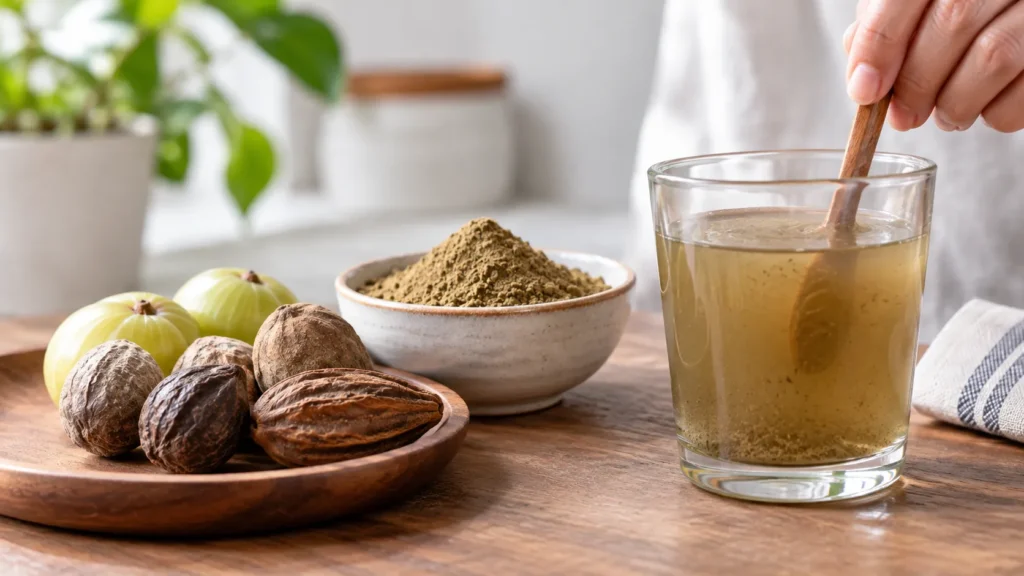
Triphala is commonly available as churna (powder), tablets and capsules. The best form is largely a matter of personal preference and convenience.
Triphala churna is the traditional powdered form. It is usually mixed with water and consumed as a drink. The taste can be quite strong, with a combination of bitter, sour and astringent flavours, so it may take some time to get used to.
Tablets and capsules are more convenient for people who don’t enjoy the taste of the powder or who want something easy to take while travelling.
There is no single Triphala dose that is appropriate for everyone. Different products can contain different concentrations and preparations, and research studies have also used different formulations. For that reason, it is better to follow the instructions on the product you are using rather than assuming that a higher amount will provide greater benefits.
If you are trying Triphala for the first time, using it cautiously and paying attention to how your body responds is a sensible approach.
Also read: Ayurvedic Remedies for Gas, Acidity & Bloating
What Is the Best Time to Take Triphala?
One of the most common questions about Triphala is whether it should be taken in the morning or at night.
Traditionally, Triphala is often taken in the evening, especially when it is being used as part of a routine for bowel regularity. Some people, however, prefer taking it in the morning or between meals.
There isn’t strong clinical evidence showing that one particular time of day is universally the best. Your reason for using Triphala and how comfortably you tolerate it are more important considerations.
If you are using Triphala as part of a digestive routine, evening use may fit naturally into your day. But if taking it at night causes stomach discomfort or otherwise doesn’t suit you, there is no need to force yourself into a particular schedule.
The simplest approach is to follow the product’s directions and use it consistently.
Also read: Pumpkin Seeds Benefits: Nutrition, Best Time to Eat
Should You Take Triphala on an Empty Stomach?
You may often see advice suggesting that Triphala should always be taken on an empty stomach. This is common in traditional guidance, but it isn’t necessarily comfortable for everyone.
Some people find it easy to take between meals, while others may experience digestive discomfort. If taking Triphala on an empty stomach does not suit you, don’t assume that discomfort means it is working.
Your individual tolerance matters.
Triphala Powder vs. Capsules: Which Is Better?
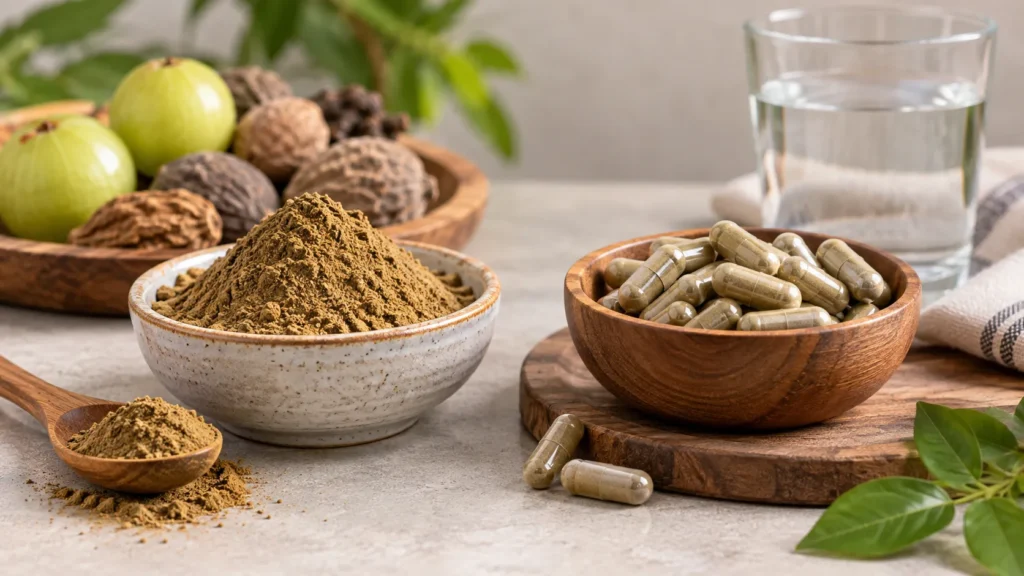
Both forms can be convenient, but they suit different people.
Triphala powder is the traditional churna form and is usually mixed with water. It may appeal to people who prefer traditional preparations, although the strong taste can be a drawback.
Capsules and tablets are easier to measure and more convenient for everyday use, particularly when travelling or when you don’t want to deal with the taste.
Neither form is automatically “better.” What matters is choosing a reputable product and checking the label carefully. Different products may contain different amounts or extracts, so two products labelled Triphala may not be exactly equivalent.
Can You Take Triphala Every Day?
Triphala has traditionally been used regularly, and clinical studies have examined daily use for periods ranging from several weeks to months. However, long-term safety information is still limited.
Because Triphala can affect bowel movements, taking too much may cause loose stools, stomach discomfort or other digestive changes.
For everyday wellness, there is also no need to assume that you must take Triphala indefinitely. If you are using it regularly for a particular health concern, especially for a long period, it is sensible to discuss that use with a healthcare professional.
What About Triphala for Weight Loss?
Search online for Triphala and you will quickly find claims that it can help burn fat or speed up weight loss.
The research is more interesting than a simple yes or no.
Some clinical trials have reported reductions in body weight, BMI and waist circumference among certain groups using Triphala. A systematic review found promising results across several trials, but also emphasized the need for larger, well-designed studies.
So, Triphala should not be treated as a weight-loss shortcut.
If you’re trying to manage your weight, the foundation remains a balanced diet, regular movement, adequate sleep and sustainable eating habits. Triphala, if used at all, should be viewed as a supplementary part of that routine rather than the main strategy.
Also read: Jamun Benefits: 12 Science-Backed Health Benefits
Triphala Side Effects and Precautions
Triphala is a traditional herbal preparation, but that doesn’t mean it is automatically suitable for everyone.
Some people may experience digestive effects, particularly when taking larger amounts. Loose stools or other gastrointestinal symptoms have been reported in clinical research.
People who are pregnant or breastfeeding, have an existing medical condition, take prescription medicines or are preparing for surgery should speak with a healthcare professional before using Triphala.
This is particularly important because Triphala may affect enzymes involved in how certain medicines are metabolized, including CYP3A4 and CYP2D6.
If you take regular medication, don’t assume that an Ayurvedic or herbal product will automatically be safe to combine with it.
A Simple Way to Add Triphala to Your Routine
If you decide that Triphala is something you’d like to try, there is no need to make your routine complicated.
Choose a reputable product and follow its instructions. If you prefer traditional preparations, Triphala churna can be mixed with water. If convenience matters more, capsules or tablets may be easier.
Start by paying attention to how your digestion responds rather than immediately increasing the amount. And remember that Triphala works best, if it is useful for you at all, as part of a broader healthy lifestyle.
Good digestion isn’t created by one herb alone. What you eat, how much fiber and water you get, how active you are and how well you sleep all play a role.
Final Thoughts
Triphala has remained popular for centuries because it is a simple combination of three traditional fruits with a long history in Ayurveda.
Its strongest traditional connection is with digestion and bowel regularity, while modern research is exploring other possible benefits, including antioxidant, metabolic and oral-health effects. Some findings are promising, but research is still developing and many of the stronger claims made online go beyond the available evidence.
If you choose to use Triphala, there is no need to turn it into a complicated health routine. Choose a good-quality preparation, follow the recommended directions and give your body time to tell you whether it suits you.
Overall, Triphala benefits may make it an interesting traditional wellness option, particularly for people interested in digestive support and general well-being.
Traditional wellness doesn’t have to mean complicated. Sometimes, the best approach is simply to understand what you’re using, use it thoughtfully and keep the bigger picture of healthy living in mind.
FAQs
1. What are the main Triphala benefits?
The most traditional benefits of Triphala are related to digestion and bowel regularity. Research has also explored its antioxidant activity and possible effects on metabolic and oral health, although evidence varies between uses.
2. What is the best time to take Triphala?
Triphala is traditionally often taken in the evening, particularly for digestive and bowel support. However, there is no strong evidence that one specific time is best for everyone.
3. Can I take Triphala every day?
Some people use Triphala regularly, and clinical studies have examined daily use. However, long-term safety evidence is limited, so regular prolonged use should be considered based on your individual needs.
4. Is Triphala good for constipation?
Triphala has traditionally been used to support bowel regularity and has a mild laxative effect. Persistent or severe constipation should be evaluated by a healthcare professional rather than managed indefinitely with Triphala.
5. Is Triphala good for weight loss?
Some studies have reported improvements in body weight and waist measurements, but the evidence is not strong enough to consider Triphala a proven weight-loss treatment.
6. Is Triphala safe for everyone?
No. People taking regular medicines or living with medical conditions should check with a healthcare professional before using it. Pregnancy and breastfeeding are also situations where professional advice is important.
7. How long does Triphala take to work?
The time can vary depending on the person, the amount taken and why Triphala is being used. When it is taken for bowel regularity, some people may notice an effect by the following morning, while digestive benefits may take longer to notice.
If you are using Triphala regularly and do not notice any improvement, increasing the amount is not necessarily the answer. It is better to review your routine and speak with a healthcare professional if digestive problems continue.
8. Can Triphala be taken with milk?
Triphala is most commonly taken with warm water, particularly when used for digestive or bowel support. Traditional guidance about taking Triphala with milk varies, so it is better not to present milk as the standard way to take it.
If you are considering taking Triphala with milk for a specific reason, follow the instructions for your particular preparation or ask a qualified Ayurvedic practitioner. For a simple everyday routine, warm water is the more straightforward option.
Disclaimer: This article is for informational and educational purposes only. It is based on traditional practices and general wellness knowledge. It is not intended to diagnose, treat, cure, or prevent any disease. Please consult a qualified professional before making any health-related changes.